Choosing between a standard cable and a custom solution comes down to your application demands. Standard cables offer convenience and lower up-front costs, but they come with predefined specifications and lack the durability needed for demanding environments.
Custom cables deliver precision-engineered assemblies to match your specific operating conditions, physical constraints and performance needs. For critical applications, consider if you need the unique durability and specs that only custom engineering offers.
5 Signs a Custom Mechanical Cable Is the Only Option
Knowing when you need custom mechanical cable solutions can save time, budget and effort. These five diagnostic signs help you decide when to use custom cables.
1. Your Operating Environment Demands Durable Materials
Tough operating conditions accelerate cable degradation and failure. Each environmental factor presents unique challenges that standard cable materials cannot withstand over time:
- High heat: High temperatures can cause standard cable materials to crack, melt or lose flexibility under normal operating conditions.
- Extreme cold: Low temperatures make materials brittle and prone to snapping under stress that would normally pose no risk.
- Moisture and humidity: Saltwater environments and humid conditions corrode unprotected cables and compromise their structural integrity over time.
- Chemical exposure: Industrial oils, solvents and cleaning agents degrade standard cable jackets in manufacturing and processing environments.
- UV radiation: Outdoor applications expose cables to sunlight that breaks down protective materials and reduces service life.
- Abrasion: Moving parts or contact with rough surfaces wear through protective layers on cables that lack adequate shielding.
Material selection directly impacts how cables perform over their service life. Custom engineering allows you to specify materials that match your exact environmental demands rather than settling for generic options that may degrade prematurely.
Marine-grade
mechanical cable assemblies show how material choices extend cable life in harsh conditions. Even through years of saltwater exposure, stainless steel construction resists corrosion while maintaining structural integrity. Galvanized coatings can add protection against moisture damage in humid environments. Using protective jackets made from nylon or vinyl creates barriers against chemical exposure, and conduits provide an additional shield against impact and abrasion that would otherwise wear through cable surfaces.
No universal cable material fits all needs. Custom solutions let you combine the right cable construction, material composition and protective coatings to ensure your assemblies survive the specific conditions they will face.
2. Your Project Has Specific Physical or Mechanical Demands
Precision matters in cable length and routing. Correct cable length prevents tangling, slack or tension, ensuring reliable performance.
Unique routing requirements compound these challenges. Tight spaces, awkward bends and complex pathways demand cables engineered for your specific installation. High-flex applications in robotics or moving machinery require materials and construction techniques that standard cables lack. Vibration speeds up wear on cables not designed for it.
Push-pull
control cable design involves multiple engineering considerations, including load capacity, routing friction, material stretch, effects of bends on effective length, temperature variations and environmental factors. When standard terminations will not work with your existing equipment,
custom-machined fittings and connectors ensure proper integration without compromising system performance.
3. Your Performance and Reliability Requirements Are Nonnegotiable
Critical systems demand cables that perform consistently under specified loads and stresses. Custom engineering ensures your assemblies meet exact load capacities, tension strength and durability requirements that generic cables cannot provide. Standard products may claim similar specifications, but they lack the validation and testing protocols required for high-stakes applications.
Rigorous
quality and proof-loading tests verify that custom assemblies meet performance specifications before they reach your facility. This level of validation ensures that the cables supporting your critical operations will handle the demands you place on them. Testing eliminates uncertainty and provides documented evidence of performance capabilities.
When failure risks safety or downtime, custom engineering delivers the reliability needed. The performance promise of a custom solution comes from purpose-built design and validated testing, not generic specifications printed on a product sheet.
4. You Must Comply With Strict Industry or Regulatory Standards
Regulated industries operate under strict component requirements. Aerospace applications, medical device manufacturing,
automotive assembly operations and military systems all require specific certifications and documentation that off-the-shelf cables rarely provide. These standards exist to ensure safety, reliability and consistent performance across applications where failure carries serious consequences.
- Medical device manufacturing requires assemblies that meet rigorous International Organization for Standardization (ISO) standards for biocompatibility, traceability and quality control.
- Military and defense applications often specify MIL-DTL standards that mandate precise material compositions, construction methods and testing protocols.
- Automotive suppliers must demonstrate compliance with industry-specific requirements that govern everything from material selection to environmental resistance.
Standard cables lack the controlled manufacturing processes, material traceability and documentation that regulated applications demand. Custom manufacturing provides the paper trail, material verification and process controls that regulatory compliance requires while giving you assemblies engineered to meet the specific industry standards.
Meeting demanding standards in regulated industries requires custom solutions built with compliance as a foundational requirement.
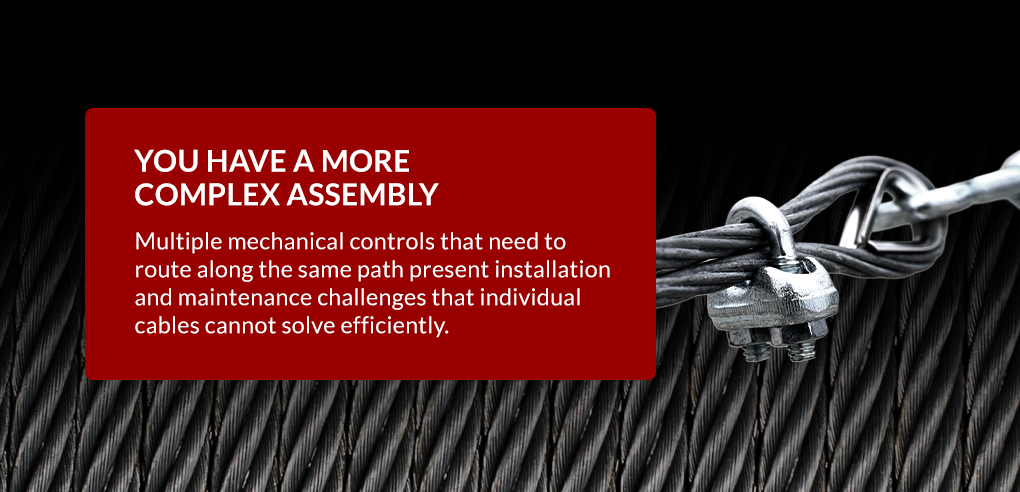
5. You Have a More Complex Assembly
Some applications require more than a single point-to-point cable. Multiple mechanical controls that need to route along the same path present installation and maintenance challenges that individual cables cannot solve efficiently.
Running multiple cables separately can create a tangled mess that complicates installation, increases the risk of snagging or damage during operation and makes maintenance difficult. Consider a control lever with one cable for forward and reverse movement plus a second cable for left and right steering. Managing these as separate components quickly becomes unwieldy.
Heavy-duty truck trailer connections demonstrate this challenge clearly. A commercial trailer requires multiple control cables, such as air brake lines, electrical connections for lighting, anti-lock braking system (ABS) sensor cables and auxiliary power feeds. A custom-bundled assembly takes these individual cables and binds them into a single, protected harness that cleanly routes from the tractor cab to the trailer connection point. This approach simplifies installation for truck manufacturers and protects the cables from road debris, weather exposure and the constant flexing that occurs during coupling and uncoupling operations.
Calculating the ROI of a Custom Cable Solution
Custom assemblies may cost more initially, but save money over their lifespan. Component failure creates hidden costs such as:
- Manufacturing downtime: Failed components halt production while you wait for repairs, leaving labor idle and equipment unused.
- Delayed shipments: Production stoppages push delivery dates back, straining customer relationships and risking contract penalties.
- Product recalls: A cable assembly that fails in your finished product triggers warranty claims, customer dissatisfaction and expensive recall processes that damage profit margins.
- Reputational damage: Projects that miss deadlines or products that fail in the field hurt client relationships and jeopardize future business opportunities.
Custom cable assembly
benefits extend beyond the initial purchase price. Assemblies built to your exact specifications deliver advantages that reduce the total cost of ownership (TCO):
- Better performance: Cables engineered for your specific application operate more reliably under your actual operating conditions.
- Enhanced durability: Purpose-built materials and construction extend service life and eliminate premature failures.
- Improved efficiency: Proper specifications reduce friction, improve response times and optimize system performance.
- Lower maintenance costs: Durable assemblies require less frequent replacement and reduce ongoing service expenses.
When you weigh modest additional up-front costs against potentially significant downstream expenses, custom engineering becomes the financially prudent choice for applications where performance, safety and reliability matter.
Find Custom Cable Solutions to Match Your Needs
Motion Control Technologies engineers custom mechanical cable solutions for industries where performance and reliability matter most. We design, prototype and manufacture assemblies that meet your exact environmental, physical and regulatory requirements, from marine-grade stainless steel cables to assemblies meeting the rigorous ISO standards required in medical device manufacturing.
Contact our engineers today to discuss your project specifications.


You must be logged in to post a comment.